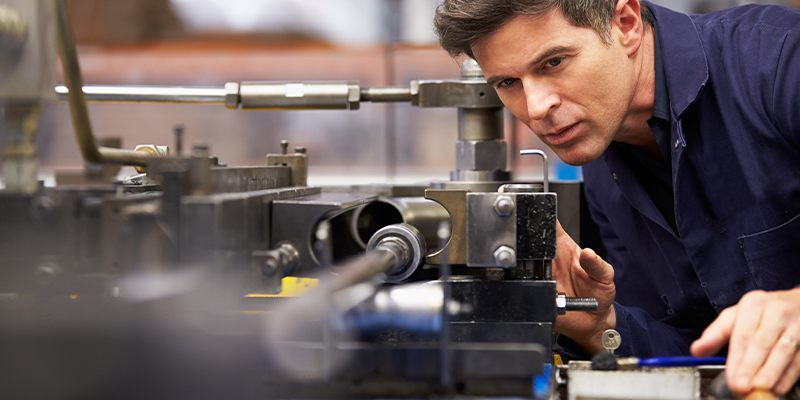
Vibration isolation is the process of isolating an object, such as a piece of equipment, from the source of vibrations. Vibration is undesirable in many domains, primarily engineered systems and habitable spaces, and methods have been developed to prevent the transfer of vibration to such systems.
Vibration isolation solutions work to isolate sensitive equipment from a severe vibration environment, like a factory floor running several large heavy machines. Solutions can also be used to isolate an environment, such as the interior of a car, from vibration forces being generated from something like the engine.
Bilz products cover a wide range of applications. From the isolation of a single press with isolation pads up to active vibration isolation of highly sensitive equipment in the semiconductor industry, there is virtually no technical product for which we cannot provide an efficient and cost-effective solution. The following is a quick overview of Active Isolation System AIS(™).
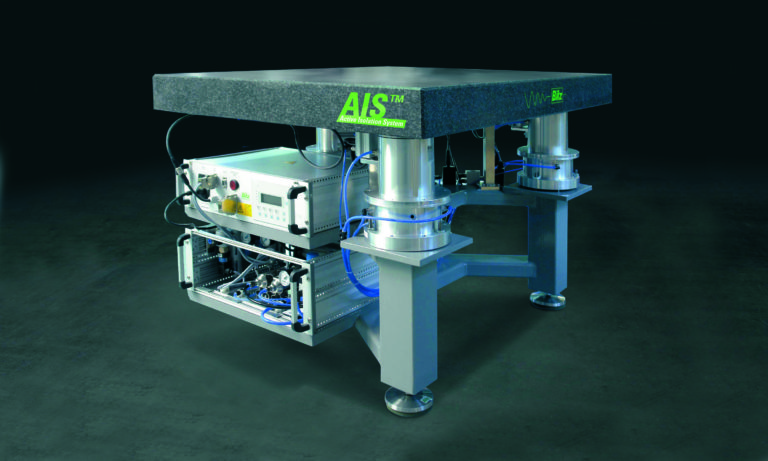
With the creation of smaller and smaller components, the vibration isolation solutions required to protect the vibration sensitive facilities poses an ongoing challenge. In order to precisely carry out sensitive experiments and measurements on a scale of nanometers (1 nanometer = one millionth of a millimeter), external disturbances, such as fluctuations in temperature, humidity and air pressure, noise, electromagnetic fields and ground vibrations must be kept to a minimum.
Passive membrane air springs, air bearings or active vibration isolation systems are used to provide high quality vibration isolation. Depending on customer requirements, BILZ can create custom solutions like a complete foundation block or platform design, or help with the layout and structural integration of the isolation system into the machine.
BILZ Vibration Technology AG has developed international expertise as a professional partner in providing solutions such as lab isolation (foundation block or platform isolation) and direct isolation of highly sensitive machines (installation of isolation systems in facilities / equipment).
We are very proud to have equipped the most modern research labs in the world with sound and vibration isolation, such as the “Präzisionslaboratorien MPI Stuttgart“ (Precision Laboratories) and the “Noise-Free Labs” of the Binnig and Rohrer Nanotechnology Centre (IBM/ETH Zurich). In the semiconductor industry, many famous companies such as Applied, Vistec and Zeiss number among our valued customers.
Bilz is able to respond to different customer requirements quickly and flexibly due to the high level of in-house vertical integration. If you are interested in learning more about vibration isolation solutions give us a call.
{{cta(‘b8d1001a-9d83-407f-91d9-924b0e200dbd’,’justifycenter’)}}